
What Does "Sangam" Mean in Satta Matka?
In the context of the Indian numbers market, the word Sangam translates to "confluence" or "union." It represents a composite outcome that relies on the results of both the Open session (the first draw) and the Close session (the second draw) of a specific market.
Unlike a simple Jodi, which is formed by combining the single digits from the Open and Close sessions (e.g., 3 and 7 forming the Jodi 37), a Sangam incorporates the underlying three-digit panels (also known as Panas or Pattis) into the equation. Because predicting the exact sequence of a three-digit panel is inherently more complex than predicting a single digit, Sangam formats are considered advanced structural records.
Half Sangam Explained
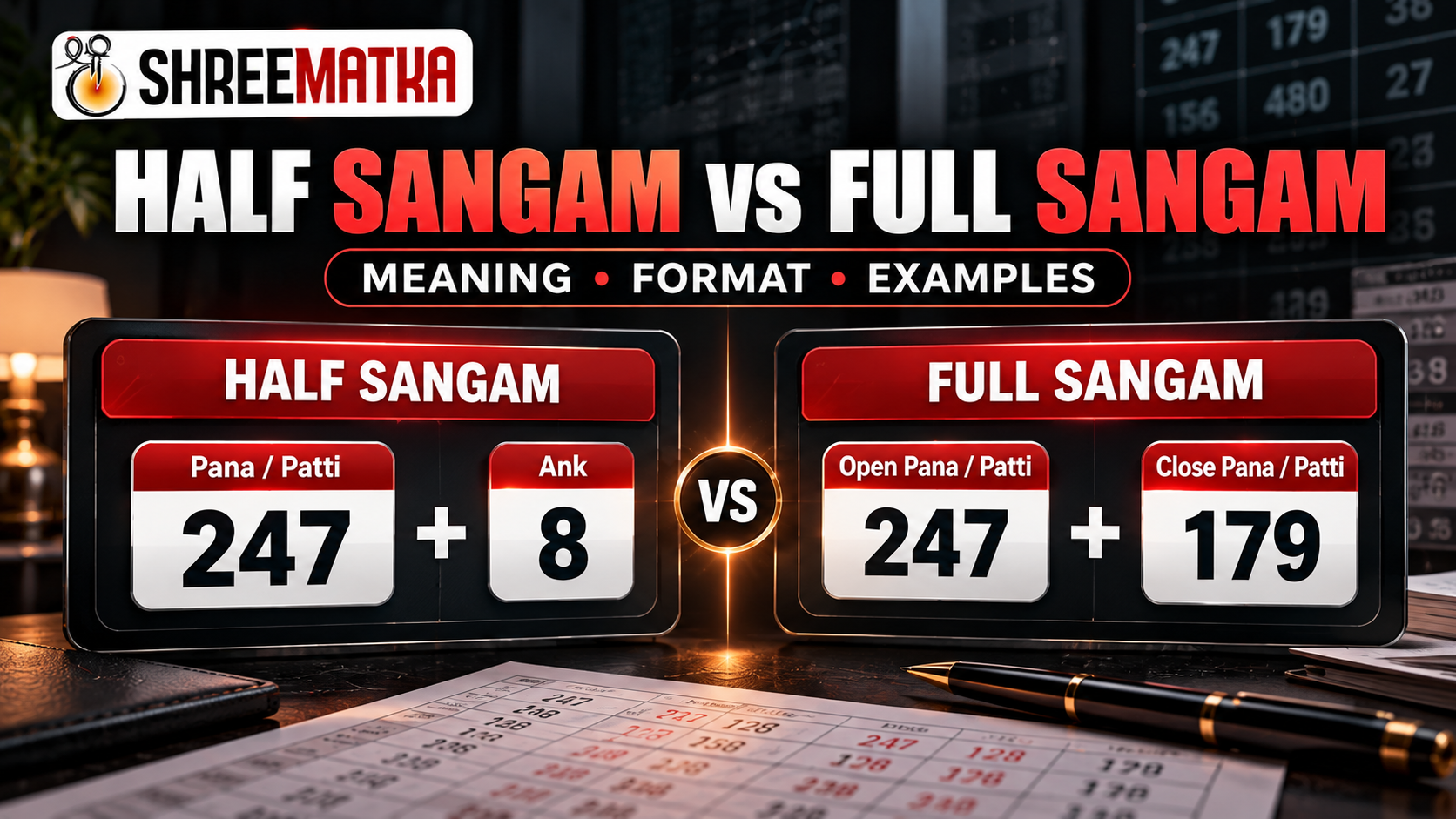
A Half Sangam is a hybrid format. It is "half" because it utilizes the full three-digit panel from one session, but only the simplified single digit from the other session.
Because the market consists of an Open session and a Close session, a Half Sangam can take two distinct forms depending on which session provides the panel and which provides the digit. On the MatkaFun platform, both configurations are recognized and tracked.
Configuration 1: Open Pana + Close Ank
In this configuration, the full three-digit panel from the Open session is combined with the single digit (Ank) from the Close session.
Pana: 148 (Digit: 3)
Pana: 269 (Digit: 7)
Configuration 2: Open Ank + Close Pana
Conversely, this configuration pairs the single digit (Ank) from the Open session with the full three-digit panel from the Close session.
Pana: 148 (Digit: 3)
Pana: 269 (Digit: 7)
Full Sangam Explained
A Full Sangam is the most comprehensive representation of a day's draw. It completely ignores the reduced single digits and instead combines the full three-digit Open Panel with the full three-digit Close Panel.
Because a Full Sangam requires the exact occurrence of two specific three-digit panels, it represents the complete mathematical state of the market for that day.
Pana: 148
Pana: 269
Need to review historical Panel Charts?
Analyze past Open and Close Panas to understand Sangam combinations on our dedicated charts page.
Key Differences: Half Sangam vs. Full Sangam
Understanding the distinction between these formats is crucial for accurate chart reading and historical analysis.
| Feature | Half Sangam | Full Sangam |
|---|---|---|
| Components | 1 Panel (3 digits) + 1 Single Digit (1 digit) | 2 Panels (6 total digits) |
| Formats | XXX-Y or X-YYY | XXX-YYY |
| Complexity | Intermediate level of detail | Maximum level of detail |
| Data Reliance | Requires the exact panel for only one session | Requires the exact panels for both sessions |
How Sangams Appear on Matka Charts
When observing a traditional Panel Chart, the Sangam is simply the visual presentation of the day's total draw sequence.
A standard Panel Chart entry looks like this: 148 - 37 - 269. This entry intuitively contains both Sangam types if you know where to look:
- The Full Sangam is visible by reading the left and right panels, ignoring the center Jodi:
148-269. - The Half Sangam (Open Pana + Close Ank) is visible by reading the left panel and the second digit of the center Jodi:
148-7. - The Half Sangam (Open Ank + Close Pana) is visible by reading the first digit of the center Jodi and the right panel:
3-269.
Frequently Asked Questions
What does Sangam mean in Satta Matka?
What is a Half Sangam?
What is a Full Sangam?
How does Sangam differ from a Jodi?
Explore Satta Matka Charts on the MatkaFun App
Stay informed with instant live results, comprehensive historical Jodi and Panel records, and verified market tables directly on your Android device.
Download Official App
Comments (0)
Loading comments...